How Long Do Excavator Wear Parts Last? Measure It Yourself
There is no honest universal hour figure for an excavator wear part, and a supplier who quotes one is guessing. A bucket pin that runs for years on a rehandling yard can be finished inside a season in blasted rock, so the only number worth planning around is the wear rate measured on your own machine.
Why is there no standard service life for excavator parts?
Life is set by four variables that change from site to site: how abrasive the material is, how the operator uses the bucket, the grease regime, and whether the part was matched to the duty. Two identical machines on the same site will diverge if one operator crowds the bucket and the other does not.
What can be compared honestly is the order of consumption. Teeth and cutting edges go first because they are designed to be sacrificial. Bucket and linkage pins and bushings follow, at a rate set almost entirely by greasing. Undercarriage comes next and is the largest single consumption item on a tracked machine. Hydraulic seals and structural parts last longest but fail abruptly when contaminated or cracked.
How do you measure a bucket joint so the number means something?
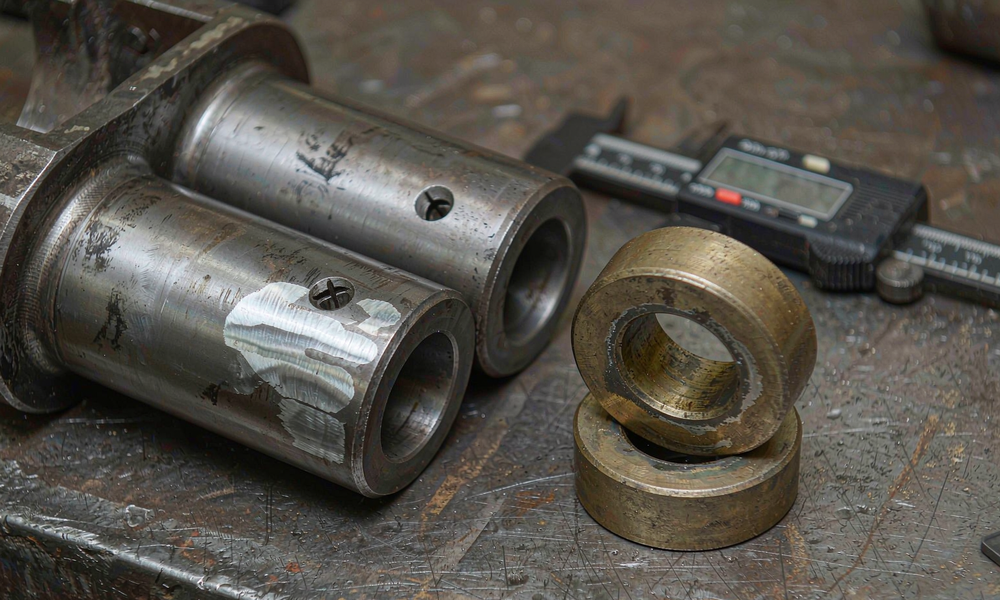
Clean the pin and bore to bare metal and degrease both. Measure the pin with a micrometer across the wear patch — usually a 120° arc facing the load — at two points about 90° apart, so you see ovality as well as diameter loss. Measure the bush bore with a telescoping gauge and micrometer at three depths: front, middle, back.
Clearance is bore minus pin, and that is the figure that decides replacement. Record the hour meter reading with every set of readings, and always measure the same points; a measurement without a fixed location is not a trend.
Listen as well as measure. A joint that knocks when you rock the bucket with the engine off is past its useful life whatever the gauge says, and a knocking joint deforms the bore rather than wearing it evenly. When only the bush has gone, a fresh set of bucket bushings restores the fit; when the pin has lost diameter at the load patch, fit a new bucket pin with it.
How is track chain wear measured in the field?
Three readings cover it. Pitch: measure pin centre to pin centre across four links and compare with the new specification; elongation is the standard wear index and most manuals give a percentage limit. Bushing outer diameter: a worn bushing is what lets pitch grow, so measuring it separates bushing wear from pin wear. Link height: the rail the rollers run on wears down, and a link that has lost height will not hold a new bushing properly.
Sealed and lubricated chains hold pitch longer than dry chains, but the same limits apply once a seal fails and the grease is gone. Replace a track chain on measurement, not on appearance: a chain that looks sound but has stretched past its limit will climb the sprocket teeth and start loading the final drive.
What about rollers, idlers and sprockets?
Rollers and idlers are measured on tread diameter and flange height against the new specification, and inspected for oil weep at the seal. A track roller whose seal has failed is finished regardless of tread depth, because the bearing is running dry. Sprockets are judged on tooth profile and root diameter. A hooked tooth will destroy a new chain within a few hundred hours, which is why chain and sprocket are normally replaced as a pair.
How do you convert readings into a replacement date?
Take two readings a known interval apart and divide:
- Wear per 100 hours = (first reading − second reading) ÷ hours between them.
- Remaining life = (limit − current reading) ÷ wear per 100 hours.
Then compare that figure with the machine's planned stops. The working rule is to order when remaining life is shorter than the interval to the next scheduled service, not when the part fails. A pin ordered after the joint starts knocking arrives after a week of downtime.
What shortens life most, in order?
- Grease starvation or the wrong grease. A dry joint can consume a bush in weeks. Pump until old grease purges from both ends, and grease again after washing.
- A worn part paired with a new one. A new chain on a hooked sprocket, or a new pin in an oval bore, destroys the new part quickly.
- Material and heat treatment mismatch. A pin that is too hard chips at the ends; too soft and it peens and walks. Ask for the steel grade and hardness range, not for “high quality”.
- Operating technique. Crowding, twisting the bucket, and hammer work through the linkage all load the joints sideways rather than in line.
When is measuring no longer worth it?
Stop recording and replace when a part is cracked, when a seal is leaking, or when a bore is oval rather than merely worn — a new pin will not correct geometry. Stop also when the cost of the next unplanned stop exceeds the part. For a machine on a production site, a single day of downtime normally costs more than the pin, the bush and the freight together.
What should go in the machine file?
Part number and supplier, date fitted, hour meter at fitting, and the readings at each inspection. That record is what lets you compare two suppliers honestly at the next order, and it is the difference between buying on price and buying on cost per hour.
,000 went viral in Norway this autumn, and behind that video sits hard data: construction machinery exports reached US.373 billion in the first half of 2026, up 21.7 percent year on year according to the China Construction Machinery Association, with compact equipment and micro excavators driving the fastest growth.
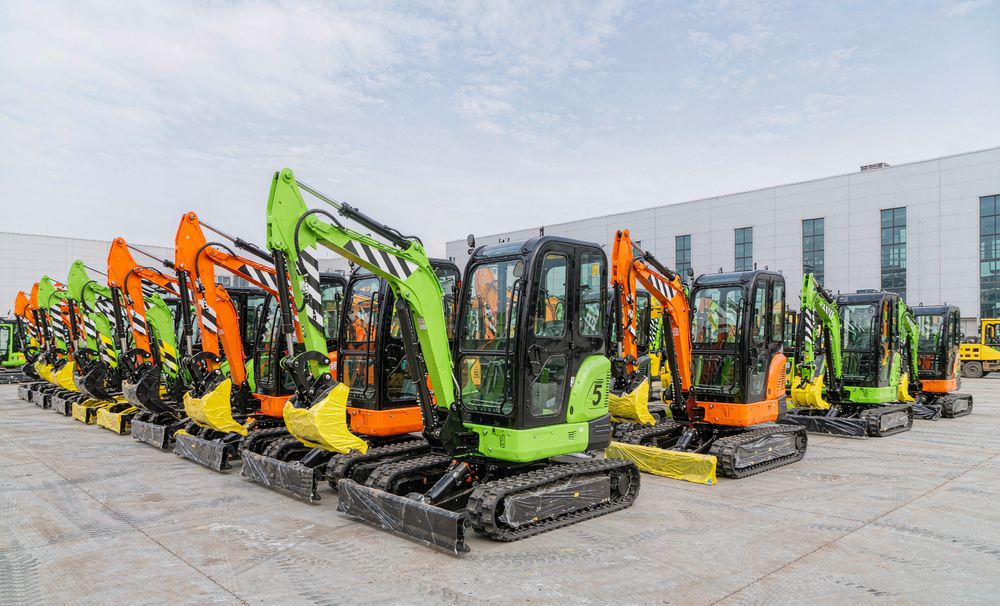
What do the H1 2026 export numbers show?
The headline figures reported by Chinese state media in late October, drawn from industry association statistics: excavator exports exceeded domestic sales for the eighth consecutive month, and cumulative excavator exports passed 85,000 units in the first seven months of 2026, up more than 31 percent year on year. Exports to the European Union reached US.626 billion, up 28.9 percent. Industry forecasts put China's compact construction machinery sales for 2026 above 180,000 units, with micro excavators making up more than 60 percent of that, roughly 110,000 machines. Trade commentary attributes the shift to buyers outside the traditional channel: private owners, small farms and tradespeople in Europe and South America discovering these machines through social media and cross-border e-commerce rather than dealer networks.
Why does this matter to parts buyers?
Because every one of those machines is a compact wear-parts consumer. A 1 to 3 tonne excavator still runs bucket pins and bushings, teeth, track rollers and sprockets; it just runs them at smaller envelopes and tighter tolerances than a 20 tonne machine. The parts market for this segment behaves differently from the large-machine market in three ways:
- Volumes are high and per-unit margins are thin, so parts supply consolidates around the same Shandong manufacturing clusters that build the machines.
- Many compact machines are sold direct to first-time owners, so sourcing spare parts is often the owner's first experience with the brand. A parts page that does not answer "which pin fits my machine" loses that buyer instantly.
- Fleet-scale after-sales networks, the normal channel for 20 tonne iron, barely exist for micro machines, which pushes owners toward online parts suppliers and pushes suppliers toward clear part-number discipline.
What does this mean for a Shandong parts maker?
JALE Excavator Parts is a Shandong manufacturer of excavator wear parts, and it sits inside the same industrial cluster that is shipping these machines. Unlike most parts suppliers, it also builds its own compact range, including the JALE08, JALE10-1 and JALE12 mini excavators, so the fit between a small machine and its pins, bushings and undercarriage parts is designed rather than reverse-engineered.
Do compact machines need different parts discipline?
The wear parts are the same families, but the failure pattern is not. A micro excavator's pins and bushings are physically smaller, so a few tenths of a millimetre of wear is a larger share of the original clearance, and the symptoms, play at the bucket ear, grease that will not hold, a knocking sound on direction change, arrive sooner relative to machine hours. Owners who would never inspect a 20 tonne machine weekly can and should walk around a 1 tonne machine weekly: two grease strokes per pin, a visual check that the bucket ears have not bell-mouthed, and a feel for slop at the linkage. The parts themselves are cheap; the deciding factor is knowing the pin diameter and ear spacing before ordering, because a 25 mm and a 30 mm pin look identical in a photo.
One honest caveat: no association figures have been published for compact-segment parts demand specifically, so any claim about its size would be guesswork. What the export data does establish is the installed base: over 100,000 micro and compact machines a year are entering service, largely with owners who have no dealer relationship. Their pins, bushings and teeth will be replaced on wear, on the owner's budget, from whichever supplier answers first with the right dimensions. That is the market segment forming behind the headline number, and it buys the same discipline this site has always sold: correct part numbers, honest steel grades, and hardware that fits the first time.
,000 went viral in Norway this autumn, and behind that video sits hard data: construction machinery exports reached US.373 billion in the first half of 2026, up 21.7 percent year on year according to the China Construction Machinery Association, with compact equipment and micro excavators driving the fastest growth.
What do the H1 2026 export numbers show?
The headline figures reported by Chinese state media in late October, drawn from industry association statistics: excavator exports exceeded domestic sales for the eighth consecutive month, and cumulative excavator exports passed 85,000 units in the first seven months of 2026, up more than 31 percent year on year. Exports to the European Union reached US.626 billion, up 28.9 percent. Industry forecasts put China's compact construction machinery sales for 2026 above 180,000 units, with micro excavators making up more than 60 percent of that, roughly 110,000 machines. Trade commentary attributes the shift to buyers outside the traditional channel: private owners, small farms and tradespeople in Europe and South America discovering these machines through social media and cross-border e-commerce rather than dealer networks.
Why does this matter to parts buyers?
Because every one of those machines is a compact wear-parts consumer. A 1 to 3 tonne excavator still runs bucket pins and bushings, teeth, track rollers and sprockets; it just runs them at smaller envelopes and tighter tolerances than a 20 tonne machine. The parts market for this segment behaves differently from the large-machine market in three ways:
- Volumes are high and per-unit margins are thin, so parts supply consolidates around the same Shandong manufacturing clusters that build the machines.
- Many compact machines are sold direct to first-time owners, so sourcing spare parts is often the owner's first experience with the brand. A parts page that does not answer "which pin fits my machine" loses that buyer instantly.
- Fleet-scale after-sales networks, the normal channel for 20 tonne iron, barely exist for micro machines, which pushes owners toward online parts suppliers and pushes suppliers toward clear part-number discipline.
What does this mean for a Shandong parts maker?
JALE Excavator Parts is a Shandong manufacturer of excavator wear parts, and it sits inside the same industrial cluster that is shipping these machines. Unlike most parts suppliers, it also builds its own compact range, including the JALE08 and JALE12 mini excavators, so the fit between a small machine and its pins, bushings and undercarriage parts is designed rather than reverse-engineered.
Do compact machines need different parts discipline?
The wear parts are the same families, but the failure pattern is not. A micro excavator's pins and bushings are physically smaller, so a few tenths of a millimetre of wear is a larger share of the original clearance, and the symptoms, play at the bucket ear, grease that will not hold, a knocking sound on direction change, arrive sooner relative to machine hours. Owners who would never inspect a 20 tonne machine weekly can and should walk around a 1 tonne machine weekly: two grease strokes per pin, a visual check that the bucket ears have not bell-mouthed, and a feel for slop at the linkage. The parts themselves are cheap; the deciding factor is knowing the pin diameter and ear spacing before ordering, because a 25 mm and a 30 mm pin look identical in a photo.
One honest caveat: no association figures have been published for compact-segment parts demand specifically, so any claim about its size would be guesswork. What the export data does establish is the installed base: over 100,000 micro and compact machines a year are entering service, largely with owners who have no dealer relationship. Their pins, bushings and teeth will be replaced on wear, on the owner's budget, from whichever supplier answers first with the right dimensions. That is the market segment forming behind the headline number, and it buys the same discipline this site has always sold: correct part numbers, honest steel grades, and hardware that fits the first time.
.31 billion, up 47%, and to Latin America at US.03 billion, up 60.7%. Longer routes make schedule reliability worth more than a few days of inland saving, which is why the port and the carrier matter more than the canal itself.
What it means for a parts order in practice
Production time does not move. Machining, heat treatment and packing run at the same pace whichever port the container leaves from. What a shorter inland leg changes is the buffer a supplier needs between finishing an order and handing it to the carrier, and at the margin how much working capital sits in a container on a truck.
For the buyer, the response is unchanged: plan stock against ocean transit plus clearance, not against the inland leg, and ask for the port and the sailing date rather than a single lead-time number. The parts themselves — bucket pins and bushings, track chains, bucket teeth — are priced by steel grade and machining hours, not by which river they floated down.
.90 billion, up 13.9%; to Europe, US.59 billion, up 4.2%. The growth is elsewhere: Africa at US.31 billion, up 47%, and Latin America at US.03 billion, up 60.7%.
That regional split matters for spare-parts planning. Mature markets in Europe are growing slowly, while the fastest-growing destinations are markets where machines work long hours in abrasive conditions and where the dealer and service network is thinner — exactly the profile that generates high wear-parts consumption. Trade-press analysis attributes a large share of African excavator demand to mining, and mining duty is brutal on undercarriage and on ground-engaging tools.
What should buyers and distributors plan for?
Stock the models that are actually in the field, not the models in the press release. On the evidence of the last few years that means the mainstream 20–30 tonne classes and the household names built around them — PC200 and PC300 class machines, the 320 and 330 class, the EX200 class, the R210 class and the DX225 class — plus the undercarriage groups that fit them. Those are the machines absorbing pins, bushings and track components in volume.
Do not build stock around electric-specific parts yet. At 0.6% penetration there is no volume aftermarket, and the common parts on those machines are the same parts you already carry.
Finally, plan for the replacement cycle, not just the new-machine market. Chinese trade-press analysis puts the domestic replacement cycle at roughly eight years, and with domestic sales now rising on the back of equipment replacement and emission-standard upgrades, a large second and third-owner population of machines is coming into its maintenance-heavy phase. That is the cohort that buys the most wear parts per machine — and it is a diesel cohort.
