Bushings in an excavator bucket do not wear evenly, and that is the whole problem. A bush that had lost material uniformly would simply open its clearance, the joint would rattle, and a fitter would replace it at the next service. What actually happens is that the bore goes out of round — it wears into a taper, an hourglass or a true oval — and the joint starts loading a narrow band of surface at several times the stress it was designed for. Understanding why excavator bucket bushings wear oval is therefore not an academic exercise: the shape of the wear tells you which of five causes is at work, and only one of those five is fixed by fitting a new bush.
The rest of this page is the geometry, the causes, the measurement, and the decision tree that a workshop should follow before it presses anything into a boss.
What oval wear is, and what it is not
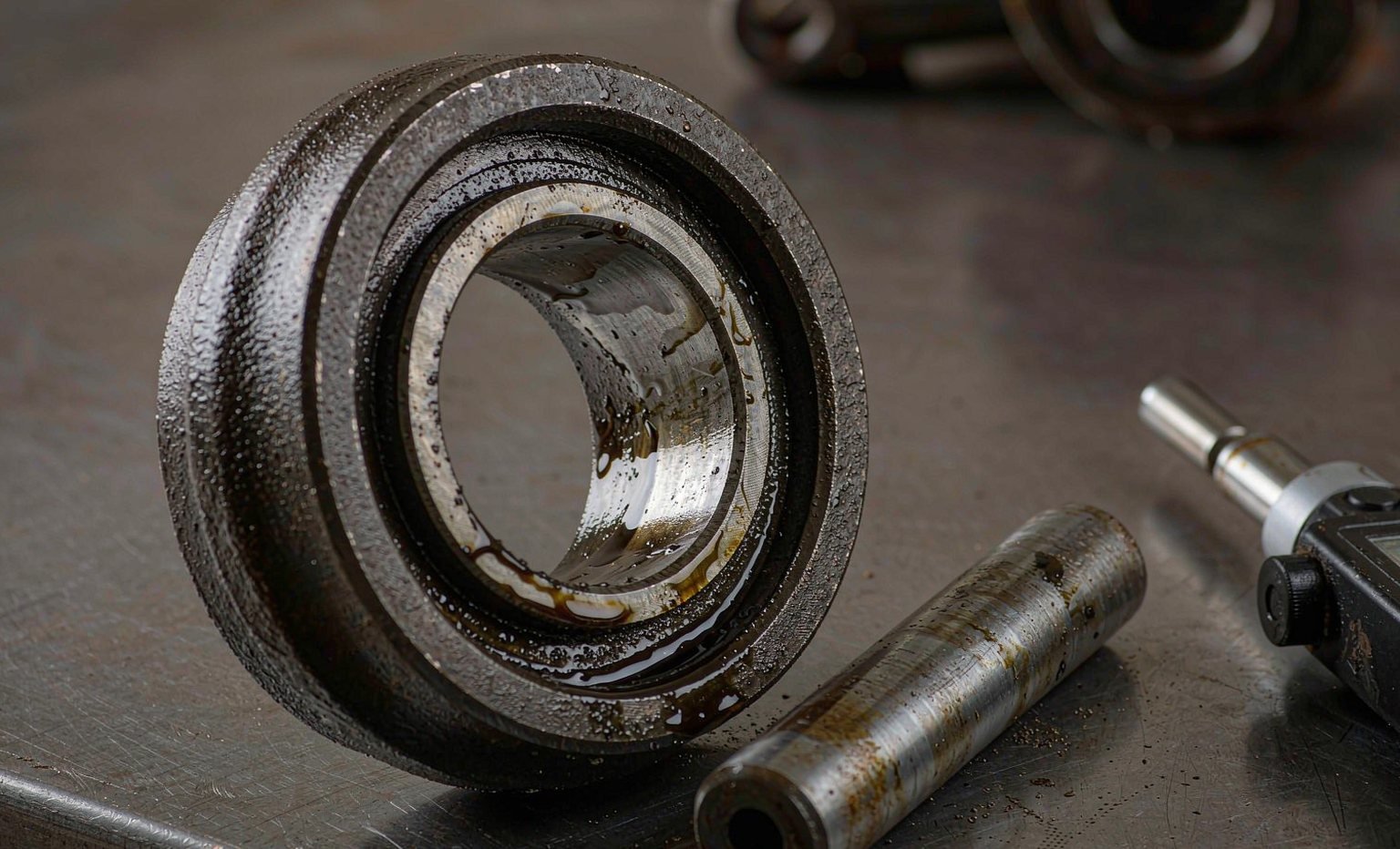
Ovality is a form error: the bore is still round enough to measure with a two-point instrument at any single position, but its diameter changes as you rotate the gauge. A bore can be perfectly cylindrical in the axial direction and still be oval in section, or it can be round at both ends and pinched in the middle, which is a barrel or hourglass form rather than ovality. Both are wear, both destroy the oil film, and both are routinely reported by fitters as "the bush is oval" because that is what a bore gauge shows when it is swept rather than read at one angle.
The distinction matters because the repair differs. Ovality is corrected by reaming or replacing. An hourglass bore usually means the pin was bending, which is a load problem rather than a bushing problem, and a new bush of the same grade will go the same way within a few hundred hours.
Roundness as a formal tolerance is defined in ISO 12181-1, and the measurement principle it sets out — a least-squares or minimum-zone reference circle, with the form error expressed as the radial separation of two concentric circles enclosing the profile — is exactly what a three-point bore gauge or an internal micrometer sweep approximates in a workshop. You do not need a coordinate measuring machine to catch a bad bush. You need to take more than one reading.
Why excavator bucket bushings wear oval at the load line
A bucket joint is a heavily loaded oscillating bearing with a very small angular travel. The bucket rotates through perhaps 120 to 150 degrees over a digging cycle, and most of the load arrives in a narrow window near the crowd and curl phases. That means the same 60 or 90 degrees of bore surface takes the great majority of the load cycles, at pressures that squeeze the grease film out and put asperity contact on the bronze.
Add the direction of the load. A bucket pin carries a radial force from the teeth, but the reaction at the boss is not a pure radial force: the offset between the cutting edge and the pin centre creates a moment, so the load distribution across the bushing length is triangular rather than uniform. The edge of the bush nearest the load sees the highest pressure, and that is where material leaves first. The result is a bore that is oval in section and tapered along its length — the classic worn bucket bushing.
Nothing about that is a manufacturing defect. It is what happens when a plain bearing is asked to run at low sliding speed, high specific pressure, and with grease rather than a pressurised oil supply. The design answer is adequate surface area, adequate hardness and a joint that stays aligned. The maintenance answer is grease that actually reaches the load zone.
The clearance band, and the three ways it grows
A pin and bush pair is specified with a diametral clearance, not a fit that is "tight" or "loose". On a 70 mm bucket pin, a working clearance of a few hundredths of a millimetre at assembly is normal, and a joint that has opened to three or four times that is finished regardless of how it looks. Clearance grows in three ways: the pin loses diameter, the bore gains diameter, or the bush moves in its housing. All three can be happening at once, and only measurement separates them.
This is why the useful number on a used joint is not "the bush is worn" but the clearance, computed from a measured pin diameter and a measured bore diameter, each taken in more than one plane. A joint with a worn pin and a good bush has a completely different repair than one with a good pin and an oval bore, and the second is the one that recurs if the cause is not addressed.
A worn pin wears the bush, not the other way round
The commonest sequence in a bucket joint starts with the pin. A hardened pin running against a bronze bush is a deliberate hardness pair: the pin is induction hardened to a hard running surface so that it resists abrasion and bending fatigue, while the bush is the sacrificial member. Once the pin's hardened case is breached — by a scored seal, by grit entering past a failed wiper, or simply by the case being too shallow for the duty — the pin starts to lose diameter in a band, and that band is no longer cylindrical.
A non-cylindrical pin cannot generate a uniform oil film. It hammers the bore twice per revolution of the joint, and because the joint only oscillates, those two hammer points stay in the same place. The bore wears oval in sympathy with the pin's wear scar. Fit a new bush onto that pin and the new bore will be destroyed in a fraction of the original life, which is exactly the complaint that follows a "we replaced the bush and it failed again" repair.
The rule is simple and routinely ignored: if the pin has lost measurable diameter, replace the pair. A pin that is 0.10 mm under nominal in a worn band is not a serviceable part, however smooth it feels.
When the bushing spins: the interference fit nobody checks
A bucket bush is held in the boss by interference, not by a key or a weld. The outside diameter is made slightly larger than the bore in the boss and the bush is pressed or chilled into place. Lose that interference — because the boss bore was worn from a previous failure and the new bush was fitted into it without measuring, or because the bush was turned down to make it "go in easier" — and the bush becomes a rotating sleeve.
A rotating bush wears on its outside diameter against a rough, unhardened boss bore, and it wears on its inside against the pin. The two wear patterns interact: as the bush rotates, the load zone on the bore migrates, and the bore ends up oval in a way that does not match the bucket's load direction. It also polishes a bright band around the boss face, which is the visual tell — a ring of fresh metal on the boss cheek beside the bush is a bush that has been moving.
Interference is a specification, not a feel. For a bush of this size a press fit in the region of a few thousandths of the diameter is typical, and every supplier should be able to state the outside diameter tolerance they hold and the boss bore it is intended for. If they cannot, the fit is being decided by whoever has the hammer.
Grease arrives late and leaves early
Grease is not a lubricant in the hydrodynamic sense here; it is a supply of oil held in a soap matrix, released slowly into the contact. That release takes time and a little heat, so a joint that is greased and immediately loaded is running on whatever film was already there. Grease also escapes: through the seals, past a worn wiper, and out of the joint under the pumping action of the oscillating pin.
Two failure patterns follow. The first is starvation at the load line, which produces a polished, dark, heat-tinted patch exactly where the load sits and leaves the rest of the bore untouched. The second is the opposite: an over-greased joint whose seals have been pushed out by pressure, so the grease path now leads straight to the outside world and grit has a clean route in.
The practical fix is interval and volume, not brand. Grease little and often, purge until clean grease appears at the seal at the start of a shift rather than at the end, and check that grease actually arrives at the far bush on a long bucket linkage. A grease nipple that accepts grease without resistance is often a nipple feeding a blocked passage, with the grease escaping past the fitting threads.
Misalignment between the ears
The bucket hangs on two bosses, and both must be coaxial. A bucket that has been run with a collapsed bush on one side, or that has been repaired by welding a new boss on without line-boring, will have its two bores out of line by more than the clearance can absorb. The pin then sits diagonally in both bushes.
The signature is a bore that is oval in a direction set by the misalignment rather than by the digging load, usually with the high wear at opposite ends of the two bushes. It is also the cause that most reliably defeats a bush replacement, because the new bushes are being asked to absorb an alignment error that has not changed. Line-boring the bosses — welding up and boring both bores in one set-up — is the only repair that holds.
Heat, hardness and the softening that is never measured
Bronze bushes are chosen for their embedding behaviour and their low friction against steel, not for their hardness. A leaded tin bronze of the SAE 660 family sits in a moderate hardness range by design, and a hardened steel or steel-backed bush will run harder but tolerates contamination less well. Neither will survive being overheated: a joint run dry at load will see local temperatures high enough to soften the bush surface and to draw the temper of the pin's hardened case.
Once that has happened, the wear rate changes permanently even if lubrication is restored. The surface is now softer than the specification, so it wears faster, which opens clearance, which increases impact, which raises temperature again. This is why a joint that has been run dry once tends to keep failing. There is no field test for this; the only evidence is colour and hardness at the surface, and by the time it is visible the part is scrap.
Measuring ovality without guessing
The measurement that matters is cheap and takes ten minutes. Pin out, bush cleaned, then:
- Bore diameter at three axial positions — front, middle, rear — because taper and barrel form both hide from a single reading.
- Each axial position read on two axes at 90 degrees, giving a maximum and minimum diameter and therefore an ovality figure per position.
- Pin diameter at the corresponding three positions, again on two axes, to find the wear band and any bend.
- Axial float and lateral play with the pin refitted, which checks the retainers rather than the bore.
- Bush condition in the boss: a bright ring on the boss cheek, or a bush that can be turned by hand, means the interference fit is gone.
| Reading | What it shows | Decision |
|---|---|---|
| Bore ovality at one position only | Load-line wear, bush still in place | Replace pair, check grease path |
| Bore taper front to rear | Moment loading or bent pin | Replace pair, check pin straightness |
| Ovality in a direction unrelated to load | Boss misalignment or spinning bush | Line-bore or restore interference first |
| Pin under nominal in a band, bore still round | Pin wear only | Replace pin, measure bore before reusing |
| Bright ring on boss cheek, bush turns by hand | Interference lost | New bush to a measured boss bore, or new boss |
| Dark polished patch with heat colour | Starvation at the load line | Replace, then fix the greasing route |
Reading the wear pattern to find the cause
Pattern is evidence. A bore worn oval in line with the bucket's curl direction, with the wear distributed across most of the bush length, is straightforward load-line wear and is the benign case. A bore worn on one side only, with the opposite side untouched and bright, is misalignment. A bore worn all round but with a coarse, gritty surface is contamination. A bore worn with a ring of damage part-way along is a grease groove that has blocked, or a pin with a step in it.
The one pattern that gets misread most often is a bore that is oval at both ends but round in the middle. That is a bending pin: the middle of the pin has been held by the bush while the ends deflect, so the ends of the bore carry the contact. Replacing the bush without checking the pin's straightness — a straightness check on a surface plate with a dial indicator, or simply rolling the pin on a flat surface — guarantees a repeat.
Repair: replace, ream oversize, or line-bore the boss
There are three legitimate repairs and one that should be refused.
Replace the pair is correct when the boss bore is still within tolerance and the wear is load-line wear. Fit a bush with the specified interference and a pin at nominal, and confirm the clearance rather than assuming it.
Ream and fit oversize is correct when the boss bore is sound but the bush has spun and taken material out of the boss, or when a previous repair has already opened the bore. Reaming to the next size and fitting a bush with a matching outside diameter restores the interference, provided the boss still has enough wall thickness and the bores are reamed in line.
Line-bore the bosses is the only correct repair when alignment has gone. It is a machining job, not a workshop job, and it is the difference between a repair that lasts and one that returns in a month.
The repair to refuse is welding up a worn boss and hand-reaming it to "about right". The bore will not be round, will not be coaxial with its partner, and will not hold interference evenly, so the new bush will be loose in some places and crushed in others before the machine has done a shift.
What to specify when you order the replacement pair
An order that gives a machine model and nothing else leaves the supplier to guess at the tolerance class, the steel grade and the bush material, and "equivalent" is doing a lot of work in that conversation. Send the numbers instead: pin diameter with tolerance, effective length between retainer faces, bush outside and inside diameters, boss bore measured in the machine, and the machine model as a cross-check rather than the primary identifier.
On the pin, state the steel and the hardening: 40Cr or 42CrMo with an induction-hardened running surface and a stated case depth is a different part from a plain turned pin in 45 carbon steel, even though both will fit. On the bush, state the material family and the hardness range, and state the interference you expect so the outside diameter can be held to suit the boss you have.
Our bucket bushing range covers bronze and steel-backed bushes in standard and oversize outside diameters, and the heavy-duty pin and bush sets are supplied as matched pairs with dimensional reports on request. For linkage joints rather than the bucket boss, the H-link bushing range uses the same interference principle at a smaller diameter.
The maintenance change that stops the next one
If one thing changes after reading this, make it the greasing routine and the measurement record. Grease on the load line at the start of the shift rather than at the end, purge until clean at every joint, and check delivery at the far end of the linkage rather than at the pump. Then record the pin and bore readings with the machine hours, so the next decision is made on a wear rate instead of a visual opinion.
A joint that is measured twice a year will be replaced on evidence, before it takes the boss with it. A joint that is only looked at when it knocks is already a machining job.